

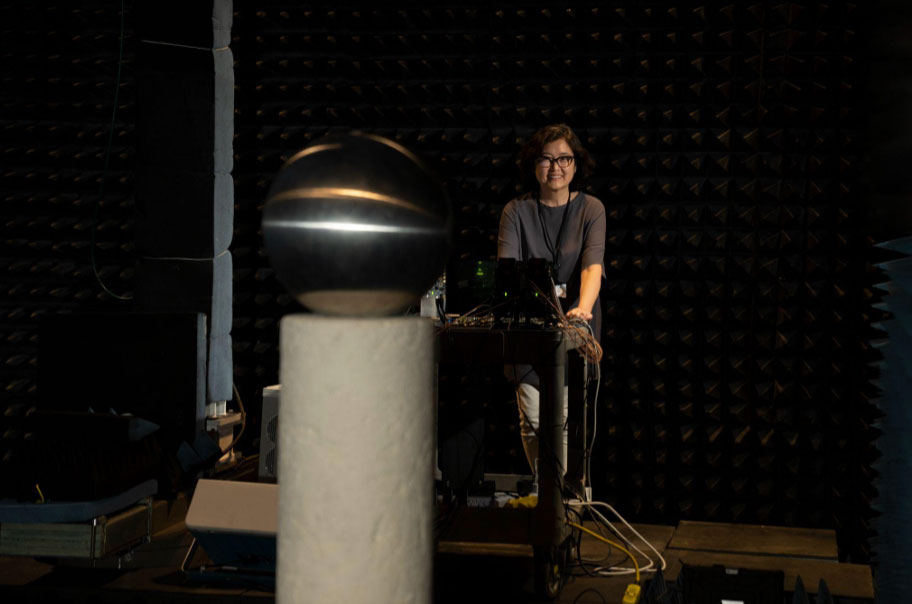
It was a bitterly cold winter day in February 1992 when Jungah Lee first set foot on the University of Illinois campus at Urbana-Champaign. She arrived from South Korea a year ago, and was uncertain about what lies ahead. She arranged a few meetings with professors to continue her graduate studies. Among them was David Munson, a distinguished professor who pioneered the mathematical formulation of Synthetic Aperture Radar (SAR) imaging. “Looking back, meeting Dave sealed my fate,” Lee recalls. “He introduced me to radar imaging and laid the foundation for everything we’re doing at Aura today. More importantly, he was a role model of how to live life.”
Fast-forward to 2025. Lee is the founder and CEO of Aura Intelligent Systems, a Bostonbased startup that revolutionizes radar technology. Aura’s digital radar solutions combine high-resolution imaging and communication functions into a single platform, paving the way for safer autonomous vehicles, robots, and intelligent infrastructure.

A Cornerstone for Safe Driving, Robotics, and Autonomous Vehicles
Aura develops advanced digital imaging radar solutions, combining high-resolution sensing and 5G-based communications into a unified platform. Their high-resolution imaging radars offer 5D situational awareness and excel in complex urban environments where interference and clutter are major challenges. “We bring fundamental changes to how radar is built. Just like mobile phones, we modulate millimeter waves digitally. This way, our radars can spatially sense the environment with high resolution, without ambiguity,” Lee explains. By enhancing safety and scalability in autonomous vehicles, drones, and fleet management, Aura paves the way for safe autonomous vehicles and robotics.
Building the Foundation: From South Korea to Academia
Lee’s journey in electronics began in Seoul. During the 1980s, electronics emerged as a critical industry. Japanese companies pioneered memory technology and BIC (Bipolar Integrated Circuit). This wave of innovation captivated Lee, and after hearing about Samsung’s announcement into the semiconductor business, she decided to pursue an electronics engineering major at Seoul National University. She was among the only two women in the class of 65 students in the Electronics Department. This marked a significant shift for a young woman transitioning from an all-girls middle and high school. Professor Park, the only female faculty member in the university's engineering school at the time, Lee recalls. “Professor Park was a guiding force for all female engineering students at the university and actively supported us in our endeavors to grow and make a difference.”
This pattern persisted throughout her career, as men dominated, especially in decision-making roles. “Even today, very few women work in electronics, in large corporations, and VCs are used to seeing certain patterns. They aren’t accustomed to seeing an immigrant woman building a successful business in the US. I’ve had to prove myself repeatedly, but I don’t mind; it made me who I am today.”
The Beauty of Signal Processing and Digital Systems
During her studies at the university, Lee discovered a passion for signal processing and digital systems. “There’s beauty in transforming physical waves into mathematical models”, she says. “Manipulating these waves to convey information or to make them interact with the physical world for sensing is truly fascinating.” After earning her master’s degree in speech processing, Lee moved to the United States with her husband, where she sought opportunities to continue her education.
In February 1992, she set up a meeting with a few professors. Munson was one of them. He offered her a research assistantship if she would pursue research in radar imaging. That opportunity steered the direction of her professional life many years later.
Mastering Technology and Business at Lucent and Samsung
Following her Ph.D., Lee’s career took a new turn. “At that time, radar was mainly used for defense applications. As a foreign student, getting a job in the defense industry was not an option. Luckily, Dave’s [Munson, red.] recommendation letter resulted in multiple offers from leading research labs. Mobile communication was booming, so I switched gears and accepted a position at Lucent Technologies.” Coming from radar imaging, she had to prove herself in this new field of research. That worked out: Jungah’s work shaped the future of 3G and 4G wireless communication. “After many years of core technology development and systems research, as a Distinguished Member of Technical Staff and later, as a product manager, I got to learn about business on a most ambitious project. I jumped right in, flew all over the world, and I loved it.”
theLater, she returned to South Korea to take on leadership roles at Samsung Electronics. As senior vice president, she led the development of a ‘Smart’ 4G LTE network and later secured funding for Samsung Emerging Business to develop the ‘Cognitiv’ LTE system. At Samsung, Lee learned to bridge the gap between technology, business, and open innovation, a skill that would prove invaluable in her entrepreneurial journey.
Taking the Leap: Founding Aura Intelligent Systems
In 2019, Lee decided it was time to address a glaring gap in radar technology. “I remember my boss at Samsung saying: ‘If you want to build a business with technology, you have to see where people invest.’ Well, at that time, autonomous driving was a hot topic.” Lee spent about six months trying to understand the key enabling technologies in the automotive industry. She realized that traditional radar systems, still based on analog technology developed during World War II, were no longer sufficient for modern needs. “With 5G and millimeter-wave technology, we transform radar by applying digital advancements. Digital radars could achieve higher resolution, greater resilience to interference, and scalability.”
She founded Aura with two patents, a business idea, and support from advisors—including Professor Munson—in 2019. “After years of working in the industry, I realized the radar I envisioned couldn’t be developed within existing companies, so I founded a startup. While many doubted the idea, I was convinced that someone has to push this through.”
Serendipity and Support: An Accidental Meeting on the Train
Launching Aura was far from easy. The COVID-19 pandemic made raising funds a daunting challenge, but Lee’s determination led her to explore alternative avenues. She secured initial funding through government grants, including The Activate Fellowship supported by DAPRA. This program led to collaboration with MIT Lincoln Laboratory. These resources enabled her to expand her team, foster a strong company culture, and access the essential lab facilities needed for Aura’s early development.
tAs Aura gained momentum, Lee’s network of investors and advisors grew. A memorable encounter occurred on a Boston train, where a fellow commuter asked about a technical magazine she was reading. Over the next 18 months, that chance meeting evolved into a meaningful investment partnership. Later, she met another angel, Ray Stata, founder of ADI, who was instrumental in setting the company’s strategy and early progress. “It’s incredible how these moments can shape a company’s journey,” Lee says.
Transforming Industries with Digital Radar
Aura’s core innovation lies in integrating radar and communication into a single platform. This advancement enables high-resolution sensing, allowing autonomous vehicles to navigate complex environments safely. While autonomous vehicles remain a primary focus, Lee highlights the potential for broader applications in robotics, augmented reality, and industrial applications. “We’re not just building radar; we’re building a foundation for an intelligent, safer world,” she explains. Aura’s long-term vision includes contributing to 6G integrated sensing and communication (ISAC), positioning the company as a leader in nextgeneration technology.
Full Circle: The Role of Mentorship and Vision
As Aura grows, Lee reflects on the pivotal role of mentorship in her journey. “Dave’s guidance at the start of my career gave me the confidence to pursue this path,” she says. The story has come full circle with Munson serving on Aura’s advisory board. Lee’s journey from an aspiring engineering student in South Korea to the founder of a groundbreaking tech company is a testament to vision, resilience, and the power of mentorship. With Aura poised to transform industries,
Lee continues to lead with the same determination that has defined her career. “We’re solving problems that have the potential to make the world a safer and smarter place,” she says. “And that’s exactly what drives me every day.”